Barcelona Card Modernista
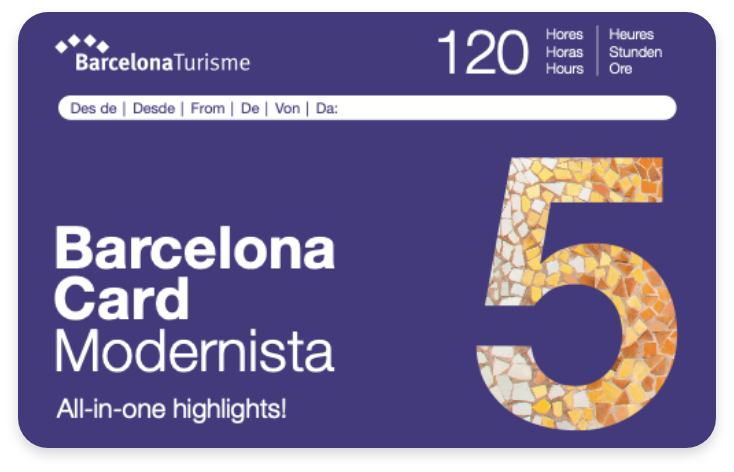
With the Barcelona Card Modernista, you can use public transportation and ten of the city’s most famous modernist buildings for free. Save up to 50%
Barcelona is often associated with the Catalan art nouveau movement known as modernisme, which flourished in the city during the late 19th and early 20th centuries and produced wonderful architectural landmarks dripping with fantasy, color, and opulence. The most notable architects of the time, including Antoni Gaudí, Domènech i Montaner, and Puig i Cadafalch, created some of the incredible structures you can visit.
Important: unlike the standard Barcelona Card, the Modernista card does not include public transport. You will need to buy a transport pass separately — the Hola Barcelona Travel Card is the recommended pairing.
Allow Modernisme to capture your attention!
What is Barcelona Card Modernista?
The Barcelona Card Modernista is a specialist tourist pass designed specifically for lovers of Catalan modernisme — the late 19th and early 20th century art nouveau movement that transformed Barcelona into one of the world’s great architectural cities. If the thought of wandering through Gaudí’s sinuous corridors or sitting beneath the stained-glass canopy of a Domènech i Montaner concert hall makes your pulse quicken, this is your card.
Unlike broader city passes that bundle museums, hop-on-hop-off buses, and airport transfers into a single product, the Barcelona Card Modernista is unapologetically focused. It gives you free entry to 10 of the city’s most iconic modernist buildings, plus unlimited public transport so you can move between them without faff. Think of it as a curated architectural itinerary, with the ticket barrier already taken care of.
The three architects who defined the movement are well represented across the included buildings:
- Antoni Gaudí — the undisputed genius of the movement, whose organic forms and mosaic surfaces still feel utterly unlike anything else built before or since. His works span the sensuous apartment blocks of the Eixample to the medieval fantasy of Torre Bellesguard.
- Lluís Domènech i Montaner — Gaudí’s great rival, whose mastery of natural light and ornamental tile work produced two UNESCO World Heritage buildings: the Palau de la Música Catalana and the Hospital de Sant Pau (Recinte Modernista).
- Josep Puig i Cadafalch — a prolific architect and politician whose houses along the Passeig de Gràcia — including Casa Amatller and Casa de les Punxes — show what the movement looked like in a more restrained, northern-European key.
Together, their buildings form a walking trail through the Eixample district and beyond that you could spend days exploring.
What’s included with Barcelona Card Modernista?
The pass covers free admission to 10 modernist landmarks. The headline buildings included in 2026 are:
- Casa Batlló (Gaudí) — one of the most photographed façades in Europe, its dragon-scale roof and bone-white balconies are instantly recognisable
- La Pedrera – Casa Milà (Gaudí) — the rooftop warrior chimneys and undulating stone facade make this Gaudí’s most architecturally radical apartment building
- Palau de la Música Catalana (Domènech i Montaner) — a UNESCO World Heritage concert hall dripping in stained glass, sculpted flowers, and ceramic mosaics
- Recinte Modernista de Sant Pau (Domènech i Montaner) — the most underrated complex in Barcelona: a UNESCO-listed former hospital campus of pavilions, gardens, and extraordinary tilework
- Palau Güell (Gaudí) — Gaudí’s first major commission for his patron Eusebi Güell; the rooftop chimneys are a preview of everything that came after
- Casa Amatller (Puig i Cadafalch) — sits next to Casa Batlló on the famous Manzana de la Discordia (Block of Discord); a neo-Gothic fantasy with a Dutch-stepped gable and chocolate-box interiors
- MNAC (Museu Nacional d’Art de Catalunya) — Catalonia’s national art museum on Montjuïc hill, with one of the world’s finest collections of Romanesque art
- Casa Vicens (Gaudí) — Gaudí’s first major house, in Gràcia, full of Moorish and Japanese references that predate his mature organic style
- Torre Bellesguard (Gaudí) — a hidden gem in the upper city that blends Gothic stonework with modernisme in a way that surprises even seasoned Gaudí fans
- Gaudí Crypt – Colònia Güell (Gaudí) — Gaudí’s experimental crypt in Santa Coloma de Cervelló, the direct prototype for Sagrada Família’s vaulting structure
Transport is NOT included. Buy a Hola Barcelona Travel Card separately to cover metro, bus, tram and airport connections.
One important omission: the Sagrada Família is not included. It requires a separate ticket (from around €26–€36 in 2026, depending on options), and it sells out weeks in advance in summer. Book it before you arrive.
How does Barcelona Card Modernista work?
The card is activated on first use — the moment you present it at your first building, the clock starts. From that point you have either 72, 96, or 120 hours (depending on the version you purchased) to use it across all included sites.
Each building allows one visit per site during the validity period. You present the card at the entrance — either the physical card or the digital version on your phone — and the ticket is validated. At most sites this also means you skip the standard ticket queue, though you may still need to book a timed-entry slot if the building operates them (Casa Batlló and La Pedrera both use timed entry, so book those slots when you purchase the card).
Transport is not included. To get between the buildings, buy a Hola Barcelona Travel Card (from €17.77 online for 2 days) which covers metro, bus, tram and airport connections. Note that the card expires on 31 December of the current year regardless of when it is activated.
Buy online in advance through the official Visit Barcelona shop or authorised resellers. You can collect a physical card at Barcelona Turisme offices (including Plaça de Catalunya and the airport terminals), or use the digital version immediately after purchase.
How can you save with Barcelona Card Modernista?
The value case for this card is genuinely compelling if architecture is your priority. Consider what the headline buildings cost individually in 2026:
- La Pedrera (Casa Milà): from €25 per adult (Essential ticket)
- Palau de la Música Catalana guided tour: €24 per adult
- Casa Batlló: from around €35 per adult (Standard Gaudí Experience)
- Hospital de Sant Pau (Recinte Modernista): approximately €18 per adult
- Palau Güell: approximately €14 per adult
- Casa Vicens: approximately €16 per adult
- Casa de les Punxes: approximately €14 per adult
Visit just four of the ten included buildings and you are already well into the territory of justifying the card price, which starts from €134 per adult for the 3-day (72-hour) version, €142 for 4 days, and €147 for 5 days. Children’s prices are significantly lower — check the official Barcelona Turisme shop for current rates at the time of booking.
The transport saving adds further value. A 72-hour T-Casual top-up costs around €12–15 in 2026; the Modernista card absorbs that cost entirely. If you are crossing the city multiple times a day between buildings, those Metro rides add up fast.
Best-value scenario: a 3–5 day stay where you visit five or more modernist buildings and use public transport daily. In that scenario, the card easily saves €60–€100 versus paying separately.
What’s to like?
The Barcelona Card Modernista is hard to beat for visitors whose trip is built around architecture. Here is what works particularly well:
- Incredible value for architecture lovers. Free entry to buildings that individually charge €14–€35 each adds up to potential savings of well over €100 across a multi-day stay.
- Pairs well with Hola Barcelona. Buy a Hola Barcelona Travel Card alongside it for unlimited metro, bus, and tram access. A 72h Hola Barcelona costs around €25.94 online — factor this into your total budget.
- Skip-the-line access at many sites. Most included buildings allow cardholders to use a dedicated lane, saving time at popular attractions that routinely have queues of 30–60 minutes.
- Covers all three great modernista architects. The building selection spans Gaudí, Domènech i Montaner, and Puig i Cadafalch — giving you the full sweep of the movement rather than just the Gaudí highlights most tourists stick to.
- Encourages discovery beyond the obvious. Buildings like Casa Vicens, Torre Bellesguard, Casa de les Punxes, and the Gaudí Crypt at Colònia Güell are places many visitors never get to — the card makes visiting them feel free, which changes the calculus entirely.
- Block of Discord in one pass. The Manzana de la Discordia on Passeig de Gràcia — Casa Batlló, Casa Amatller, and Casa Lleó Morera — are all covered. Walk 100 metres and you have visited three of the most important modernista façades in the world.
What’s not to like?
Honest assessment: this card is not for everyone. There are a few things worth knowing before you buy:
- Sagrada Família is not included. This is the single most important thing to know. The Basílica de la Sagrada Família — the building most people associate with Gaudí — requires a separate ticket from around €26–€36. Budget for this separately, and book it well in advance.
- Overkill for casual visitors. If you plan to see one or two Gaudí buildings and spend the rest of your time on the beach or in El Born’s bars, a general city pass or individual tickets will serve you better and probably cost less.
- Timed entry still applies at some sites. Casa Batlló and La Pedrera both operate timed-entry slots. The card gets you in free, but you will still need to book a time slot in advance — do this when you purchase the card for peak summer dates.
- Ten buildings in 3–5 days is genuinely ambitious. Build your itinerary with realistic dwell times. The Hospital de Sant Pau and the Palau de la Música alone could each take two to three hours including a guided tour. Don’t race through these buildings — they reward slow looking.
- Not all sites offer full skip-the-line. At a handful of included buildings, cardholders join a slightly shorter queue rather than a completely separate fast lane. This is the exception rather than the rule, but worth knowing if beating queues is your primary motivation.
- Park Güell is not included. The ticketed Monumental Zone of Park Güell (around €10) requires a separate booking — though the surrounding park is free to enter.
Who is Barcelona Card Modernista best for?
This card is a natural fit for certain types of travellers and a poor fit for others. It works brilliantly if you are:
- A dedicated architecture enthusiast who has specifically come to Barcelona because of the modernisme movement — this is your card without question.
- A Gaudí fan who wants to see not just his famous Eixample works but also the less-visited gems like Casa Vicens, Torre Bellesguard, and Palau Güell.
- An art history lover interested in tracing the full movement across all three of its defining architects: Gaudí, Domènech i Montaner, and Puig i Cadafalch.
- Visiting for 3–5 days with architecture as the primary focus of the trip — short enough that 72 or 96 hours makes sense, long enough to see five or more sites.
- Travelling in summer or during peak periods when individual ticket queues at Casa Batlló and La Pedrera can stretch to 60+ minutes — the skip-the-line benefit alone saves significant time.
It is less suitable if you are a first-time visitor who mainly wants to hit the highlights quickly, a beach-and-food traveller with one or two cultural stops, or someone staying fewer than three nights.
How to buy Barcelona Card Modernista?
The easiest and most reliable way is to book online in advance through the official Visit Barcelona ticketing shop (bcnshop.barcelonaturisme.com) or through the Barcelona Card website. Buying online means you can use a digital version immediately and skip any collection queues on arrival.
If you prefer a physical card, you can also purchase and collect at Barcelona Turisme offices in the city — most conveniently at the Plaça de Catalunya office or the airport information desks in terminals T1 and T2. Cards purchased in advance online can also be collected at these locations.
Where to pick up Barcelona Card Modernista?
Collection points include:
- Plaça de Catalunya (main Barcelona Turisme office, central city)
- Barcelona Airport Terminal T1 and T2 (arrivals halls)
- Barcelona Sants station (Barcelona Turisme desk)
- Barcelona Nord bus station
Digital cardholders can go directly to any of the included attractions without collecting a physical card — just show the QR code on your phone.
Ratings and reviews for Barcelona Card Modernista
Traveller reviews consistently highlight two things: the sense of discovery it encourages (particularly at less-visited buildings like Casa de les Punxes and Casa Vicens), and the transport integration making logistics much simpler. Architecture enthusiasts repeatedly rate it as excellent value. The most common criticism in recent reviews is the absence of Sagrada Família — which, to be fair, is clearly stated in the card’s terms and is not hidden in the small print.
On Tripadvisor and Google, the card averages around 4.2–4.5 out of 5 across thousands of reviews, with higher scores among visitors who researched the included buildings in advance and lower scores among those who expected Sagrada Família to be covered.
Barcelona Card Modernista alternatives you should know
If you are not sure the Modernista card is the right fit, consider these alternatives:
- The standard Barcelona Card — includes transport plus discounts (not free entry) at a wider range of museums and attractions, making it better for visitors who want variety rather than a deep architectural focus.
- Articket BCN — covers six major art museums (MNAC, MACBA, Fundació Miró, Fundació Antoni Tàpies, CCCB, Museu Picasso) for a single price. A better choice if contemporary and classical art interests you more than architecture.
- Individual tickets — if you only want to see two or three buildings, buying separately online (using official sites where you often get a small discount versus the door price) is perfectly sensible and more flexible.
Compare Barcelona Card Modernista with other tourist passes in Barcelona
| Barcelona Card Modernista | Standard Barcelona Card | Articket BCN | |
|---|---|---|---|
| Modernist buildings (free) | 10 | Discounts only | — |
| Public transport | Not included | Included | Not included |
| Sagrada Família | Not included | Not included | Not included |
| MNAC | ✓ Free | Discounts | ✓ Free |
| Best for | Architecture focus | General visitor | Art focus |
Final thoughts: is Barcelona Card Modernista worth it?
If modernisme is the reason you are coming to Barcelona, this is the most straightforward recommendation I can make: buy the Barcelona Card Modernista.
The combination of free entry to ten iconic buildings — Casa Batlló, La Pedrera, the Palau de la Música Catalana, the Hospital de Sant Pau, Palau Güell, Casa Amatller, Casa Lleó Morera, Casa de les Punxes, Casa Vicens, and Torre Bellesguard — plus unlimited public transport, starting from €134 for 72 hours, delivers exceptional value the moment you walk through the second or third building. Add a Hola Barcelona Travel Card (from €25.94 for 72h) for seamless transport between sites, and you have the most complete Modernisme itinerary available for a single combined price.
The key caveats are worth repeating one final time: book a separate Sagrada Família ticket before you arrive (it sells out weeks in advance in summer), and build a realistic itinerary rather than trying to squeeze all ten buildings into 48 hours.
For Gaudí fans, art history lovers, architecture students, and anyone spending three or more days in the city with a genuine interest in Catalan modernisme, this Barcelona modernist architecture pass is excellent value and a genuinely well-designed product that serves its audience well.
Casual visitors who mainly want the beach, the food market, and one or two sights are better served by something more flexible. But if you arrived in Barcelona because of the buildings — this is your card.
What options are there
- Barcelona Card Modernista 3 days (72 hours)
- Barcelona Card Modernista 4 days (96 hours)
- Barcelona Card Modernista 5 days (120 hours)